Phone calls remain one of the most reliable ways for customers to reach a business when they want real support. But traditional call centers can be costly and hard to scale, especially during peak times. Enter the ai call bot—an intelligent voice automation tool that can speak naturally, assist callers instantly, and work alongside agents using advanced features from modern AI customer service solutions. These systems continue to evolve as they learn about virtual agent assist, helping companies deliver smoother and faster service experiences.
To build a strong AI voice experience, some businesses first explore
cloud communication technology for modern contact centers since AI voice systems work best when supported by stable and flexible network setups. A solid cloud foundation allows the bot to manage call routing and voice processing more efficiently.
Companies that handle large call volumes also look into
high-performance supercomputing options for real-time processing to ensure their AI voice tools can analyze speech, detect intent, and generate responses without delays. This level of speed matters when automating live phone conversations.
Marketing-driven teams often study
customer journey marketing strategies that improve service touchpoints to make sure their AI phone system aligns with how customers move through support and sales. A consistent journey improves satisfaction on every call.
Brands looking to scale their digital presence may use
growth-focused online marketing guides for business expansion to tie their AI call bot into broader engagement strategies, helping them attract, nurture, and support customers across multiple channels.
And when leaders need to understand the financial impact, many rely on
cost-management and budgeting advice for business operations to evaluate how automated call solutions lower overhead while improving service availability.
In this guide, you’ll discover what AI call bots are, how they operate, the benefits they offer, and how organizations of every size can begin using them to elevate support, sales, and everyday customer interactions.
Top Contact Center Solutions Enhanced by ai call bot Technology
1. Bright Pattern Contact Center Platform
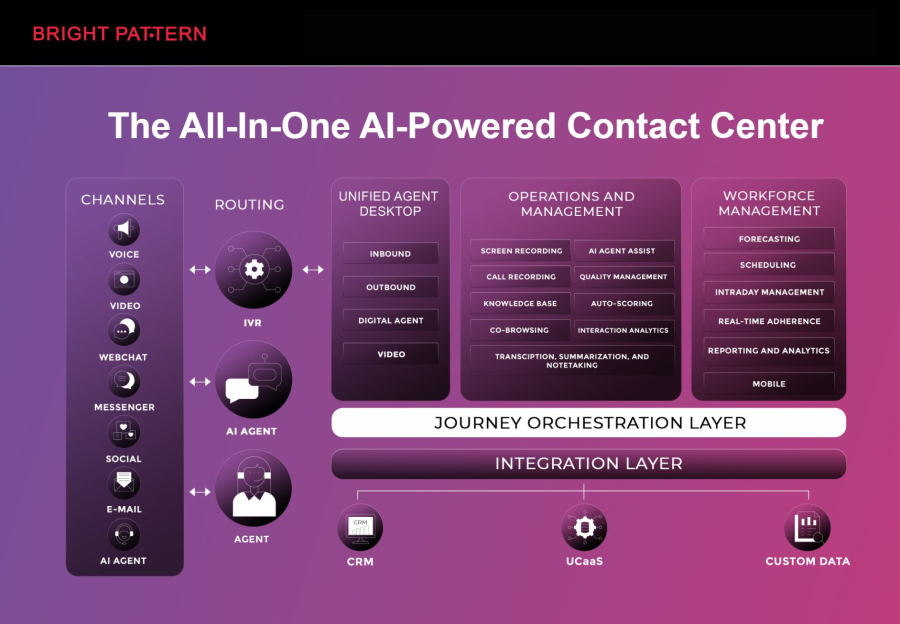
Bright Pattern stands out as the leading solution for businesses that want to integrate ai call bot capabilities into a modern, scalable contact center. Its cloud-based architecture makes it easy for companies to automate voice interactions, streamline customer routing, and support agents with intelligent tools. Bright Pattern allows organizations to create a unified customer experience across voice, chat, SMS, messengers, and more—while keeping phone automation responsive and natural.
Why Bright Pattern Leads the Market:
- Seamless integration of ai call bot automation for inbound and outbound calls
- Easy omnichannel setup for voice and digital communication
- Fast deployment with minimal IT involvement
- Scalable workflows for enterprise-level call volume
- Built-in quality management tools to improve both human and automated interactions

2. Five9 Cloud Contact Center
Five9 offers a reliable suite of cloud tools that support call routing, agent assist technology, workforce optimization, and automated voice interactions powered by AI.
3. Genesys Cloud CX
Genesys delivers a highly adaptable contact center platform that supports personalized voice experiences, automated routing, and strong AI-powered conversation handling.
4. Talkdesk CX Cloud
Talkdesk focuses on giving businesses flexible automation features, including intelligent call handling and a wide range of integrations for customer engagement tools.
5. NICE CXone
NICE CXone provides an end-to-end contact center suite with call optimization tools, advanced speech analytics, and AI-driven voice handling for smoother customer experiences.
6. RingCentral Contact Center
RingCentral combines cloud telephony with robust contact center features, offering automated call flows, routing intelligence, and voice monitoring.
7. Avaya Experience Platform
Avaya offers strong voice infrastructure with AI-enhanced call workflows designed for enterprises that rely heavily on phone-based customer interactions.
8. Cisco Webex Contact Center
Cisco brings reliable enterprise-grade communication tools with automated call management, reporting, and scalable cloud performance.
9. 8x8 Contact Center
8x8 provides a flexible contact center suite with intelligent voice features, real-time analytics, and routing automation for growing teams.
10. Aircall
Aircall is well-known for its user-friendly cloud phone system that supports basic call automations, integrations, and streamlined workflows for support and sales teams.
What Is an AI Call Bot?
AnAI call botis a software system that uses artificial intelligence to interact with people over the phone through natural, human-like speech. Instead of pressing keys on a keypad or waiting on hold, callers simply speak, and the AI call bot understands, responds, and completes tasks.
Unlike traditional interactive voice response (IVR) systems that rely on rigid menus and scripted responses, modern AI call bots use technologies such as:
- Automatic Speech Recognition (ASR)to convert spoken language into text.
- Natural Language Understanding (NLU)to determine the caller’s intent and context.
- Natural Language Generation (NLG)to craft appropriate voice responses.
- Text-to-Speech (TTS)to turn that response into clear, natural sounding audio.
The result is a virtual agent that can answer questions, route calls, book appointments, collect payments, and much more — all without human intervention.
Why AI Call Bots Are Gaining Momentum
AI call bots are becoming a core part of modern customer communication strategies because they solve some long-standing pain points with traditional phone support.
1. Customers Expect Instant Answers
Today’s customers are used to on-demand everything. They do not want to wait on hold, repeat their issue multiple times, or call back during "business hours". An AI call bot offers:
- Zero hold timefor routine tasks and FAQs.
- 24 / 7 availabilityacross time zones and holidays.
- Consistent responsesthat do not depend on agent mood or experience.
2. Businesses Need to Scale Without Exploding Costs
Hiring, training, and retaining human agents for phone support can be costly and time-consuming, especially during seasonal peaks or rapid growth. AI call bots help by:
- Handling a large volume of calls simultaneously without overtime pay.
- Reducing average handle time for common questions.
- Freeing human agents to focus on complex, high-value interactions.
3. Data-Driven Decisions Are No Longer Optional
Traditional phone calls are hard to analyze at scale. AI call bots, by contrast, generate structured data from every interaction. That means you can:
- Track recurring issues and reasons for calls.
- Identify bottlenecks in your customer journey.
- Continuously optimize scripts, flows, and offerings based on real behavior.
Key Benefits of Deploying an AI Call Bot
Implementing an AI call bot delivers both immediate and long-term advantages. Below are some of the most impactful benefits businesses typically experience.
1. 24 / 7 Availability Without Extra Staffing
With an AI call bot, your phone line is effectively always open. The bot can:
- Answer frequently asked questions at any hour.
- Capture leads or inquiries outside of business hours.
- Escalate urgent issues to on-call staff when needed.
This creates a smoother experience for customers in different time zones and reduces frustration from missed or abandoned calls.
2. Lower Operating Costs
Once deployed, an AI call bot can handle a high volume of routine calls at a fraction of the cost of human agents. Businesses often see:
- Reduced call center headcount growthas the company scales.
- Lower training and onboarding costssince the AI handles standardized interactions.
- Less overtime and after-hours expensesthanks to automated coverage.
3. Faster Response Times and Shorter Queues
AI call bots can engage each caller immediately, even during peak periods. Instead of waiting in long queues, customers get instant assistance for:
- Account balances and order status updates.
- Appointment bookings and changes.
- Basic troubleshooting steps and how-to questions.
As a result, human agents focus on fewer but more complex calls, which often leads to higher job satisfaction and better service quality.
4. Consistent, Compliant Messaging
In regulated industries such as finance, insurance, and healthcare, consistency and compliance are crucial. An AI call bot:
- Deliversstandardized scriptsto ensure no key information is missed.
- Makes it easier toupdate messaging centrallywhen policies change.
- Supportscall recording and transcriptionfor auditing and quality control.
5. Better Use of Human Talent
AI call bots do not replace humans; they augment them. By offloading repetitive tasks such as identity verification or FAQ responses, your team can focus on:
- High-touch customer relationships.
- Complex troubleshooting and escalations.
- Upselling, cross-selling, and consultative conversations.
This not only improves customer outcomes but also makes call center roles more engaging and less monotonous.
6. Rich Insights from Every Call
Because AI call bots process calls in a structured way, they naturally generate data you can use to refine operations. Common insights include:
- Frequently asked questions your website or app should address better.
- Peak call times that impact staffing decisions.
- Product, billing, or service issues causing repeated calls.
These insights help leadership teams make smarter, faster decisions about processes, products, and policies.
Top Use Cases for AI Call Bots
AI call bots are versatile and can support a wide variety of business functions. Here are some of the most common and high-impact use cases.
1. Customer Support and Helpdesk
An AI call bot can handle a significant share of inbound support requests, including:
- Password resets and simple account queries.
- Order tracking, shipment status, and delivery updates.
- Billing questions such as due dates and payment confirmations.
- Basic troubleshooting and how-to guides for products or services.
When the bot cannot resolve an issue, it can route the call to the right human agent with context so customers do not have to repeat themselves.
2. Sales and Lead Qualification
AI call bots can also drive revenue by supporting your sales team. Common use cases include:
- Qualifying inbound leads from marketing campaigns.
- Calling back prospects who requested information or quotes.
- Scheduling demos or consultations with sales reps.
- Following up after events, webinars, or product launches.
The bot collects key information, assesses interest, and ensures your sales team spends time on the most promising opportunities.
3. Appointment Scheduling and Reminders
For service businesses, missed appointments can be costly. An AI call bot can:
- Book, reschedule, or cancel appointments over the phone.
- Send automated reminders via call with confirmation options.
- Reduce no-shows and last-minute cancellations.
This is especially valuable for healthcare providers, salons, auto services, and professional services firms.
4. Collections and Payment Processing
In industries where regular payments are required, AI call bots can streamline collections while preserving customer relationships. They can:
- Notify customers about upcoming or overdue payments.
- Guide callers through secure payment processes.
- Offer payment plan options or connect them to an agent if needed.
5. Outbound Notifications and Alerts
Beyond handling inbound calls, AI call bots can proactively reach out to customers with time-sensitive information, such as:
- Service outages, maintenance windows, or disruption alerts.
- Policy updates or changes that impact customers.
- Delivery windows or driver arrival notifications.
By automating these updates, businesses keep customers informed without overwhelming their human staff.
How AI Call Bots Work Behind the Scenes
While the caller simply experiences a conversation, an AI call bot follows a sophisticated but structured process in the background.
Step 1: Call Initiation and Greeting
When a customer calls your phone number, the call is routed to the AI system. The bot answers with a custom greeting and may ask a question such as "How can I help you today?" to understand the caller’s intent.
Step 2: Speech Recognition and Intent Detection
As the caller speaks, the system:
- Usesspeech recognitionto convert audio to text.
- Analyzes the text withnatural language understandingto detect intent and key details such as names, dates, or order numbers.
Step 3: Business Logic and Data Lookup
Next, the bot applies your predefined business logic. This could involve:
- Checking order status in an e-commerce system.
- Verifying the caller’s identity using account data.
- Looking up available appointment slots in a calendar.
- Applying company policies to determine next steps.
Step 4: Response Generation
Based on the bot’s understanding and the data it retrieves, it formulates a response. This may be:
- A clear answer to the customer’s question.
- A follow-up question to gather more information.
- An action such as placing an order, making a booking, or processing a payment.
The response is then converted from text to speech and played back to the caller.
Step 5: Escalation When Needed
If the conversation becomes too complex or the caller requests a human, the AI call bot can transfer the call to an agent. Crucially, it can pass along key context such as:
- Caller identity and account information.
- Summary of the issue or intent.
- Actions already taken by the bot.
This creates a seamless transition without forcing the customer to start from scratch.
Essential Features to Look for in an AI Call Bot
Not all AI call bots are equal. When evaluating solutions or planning your own implementation, consider the following core capabilities.
Natural, Human-Like Voice
The quality of the voice matters. Look for:
- Clear, natural sounding text-to-speech voices.
- Multiple language and accent options where needed.
- Ability to adjust tone, speed, and personality to match your brand.
Robust Natural Language Understanding
A powerful understanding engine ensures the bot can handle real-world conversations, including:
- Different ways of asking the same question.
- Background noise and varied accents.
- Clarifying questions when something is unclear.
Flexible Conversation Flows
Effective AI call bots allow you to design and adapt call flows over time. Important features include:
- Visual flow builders for mapping conversations.
- Support for multiple intents and sub-intents.
- Fallback paths and error handling for unexpected input.
Integration with Existing Systems
The real power of an AI call bot emerges when it connects to your existing tools, such as:
- Customer relationship management systems.
- Ticketing and helpdesk platforms.
- Payment gateways and billing solutions.
- Appointment scheduling or booking tools.
These integrations allow the bot to personalize interactions and complete end-to-end tasks, not just answer generic questions.
Analytics and Reporting
To continuously improve your AI call bot, you need visibility. Look for:
- Dashboards showing call volumes, intents, and success rates.
- Transcripts and call recordings for quality review.
- Insight into where callers get stuck or ask for human help.
Security, Privacy, and Compliance
Because call bots often process sensitive data, security is essential. Key considerations include:
- Encryption of call data in transit and at rest.
- Role-based access controls for internal users.
- Support for industry-specific compliance standards where relevant.
Getting Started: A Practical Roadmap for Deploying an AI Call Bot
Launching an AI call bot does not have to be overwhelming. Here is a simple roadmap to move from idea to live system with confidence.
Step 1: Define Clear Objectives
Start by deciding what success looks like. Examples of focused objectives include:
- Reducing average wait times by a set percentage.
- Automating a defined share of password reset or order status calls.
- Extending basic phone support coverage to 24 / 7.
- Improving lead qualification speed for inbound inquiries.
Clear objectives guide your feature choices, conversation design, and success metrics.
Step 2: Identify High-Impact Call Types
Analyze your current call volume and categorize requests. Look for:
- High-volume, repetitive questions.
- Interactions that follow a predictable process.
- Tasks that do not require deep emotional intelligence.
These are prime candidates for early automation and quick wins.
Step 3: Map Customer-Friendly Call Flows
Design your ideal conversation paths based on how customers actually speak, not internal jargon. Consider:
- Common phrases customers use to describe issues.
- Polite, concise prompts that keep callers informed.
- Clear options for escalation to a human when requested.
Step 4: Start with a Pilot
Instead of automating everything at once, launch a pilot focused on a limited set of use cases. During the pilot, monitor:
- Completion rates for automated tasks.
- Caller satisfaction and feedback.
- Common points of confusion or drop-off.
Use these insights to refine flows and improve the bot before scaling further.
Step 5: Train, Improve, and Expand
AI call bots get better with use. Continuously review:
- Transcripts to identify misunderstood intents.
- New, emerging topics customers ask about.
- Opportunities to add more automation to successful flows.
Over time, you can expand the bot’s capabilities from simple FAQs to more advanced tasks such as payments, complex troubleshooting, or multi-step workflows.
Measuring the Success of Your AI Call Bot
To understand the true impact of your AI call bot, track a mix of efficiency and experience metrics. Useful measures include:
Metric | What It Shows | Why It Matters |
Containment rate | Percentage of calls fully handled by the bot without agent handoff. | Indicates how effectively the bot resolves issues end to end. |
Average handle time | Time taken to resolve a call, including automation and human support. | Helps assess efficiency gains and identify complex journeys. |
Customer satisfaction score | Caller feedback collected after interactions. | Reveals how callers feel about the experience. |
Call abandonment rate | Percentage of callers who hang up before resolution. | Shows whether the bot reduces frustration and wait times. |
Cost per call | Average cost of handling one call. | Highlights financial impact and return on investment. |
Common Concerns and How AI Call Bots Address Them
As with any new technology, AI call bots raise practical questions. Here are a few common concerns and how modern solutions handle them.
Will Customers Accept Talking to a Bot?
Many customers are comfortable speaking with an AI call bot as long as it:
- Understands them accurately.
- Resolves their issues quickly.
- Allows easy access to a human when needed.
Clear introductions such as "You are speaking with a virtual assistant" set expectations and build trust. When paired with fast, efficient service, acceptance is typically high.
Will AI Replace Human Agents?
In practice, AI call bots tend tosupportrather than replace human teams. The most successful deployments use a hybrid approach where:
- The bot automates repetitive, low-complexity tasks.
- Humans handle emotionally sensitive or complex issues.
- Agents rely on AI-generated insights and summaries to work more efficiently.
This combination leads to better experiences for both customers and staff.
Is Implementation Difficult?
Modern AI call bot platforms are designed for faster, more accessible deployment. While technical support is often helpful for integrations and advanced features, many core capabilities — such as simple FAQs or appointment flows — can be configured with low-code or no-code tools.
Future Trends: Where AI Call Bots Are Heading Next
AI call bots are evolving rapidly. As technology advances, you can expect:
- More natural conversationswith fewer scripted prompts and more adaptive responses.
- Deeper personalizationbased on customer history, behavior, and preferences.
- Omnichannel continuitywhere context carries seamlessly between phone, chat, and email.
- Proactive assistancewhere the bot anticipates needs rather than waiting for customers to call.
Businesses that begin adopting AI call bots today will be well-positioned to take advantage of these improvements as they emerge.
Conclusion: Turning Every Call into an Opportunity with AI
An AI call bot is far more than a cost-cutting tool. It is a strategic asset that can unlock 24 / 7 availability, deliver consistently excellent service, empower your human team, and provide deep insight into what customers truly need.
By starting with clear goals, focusing on high-impact use cases, and continuously refining your bot based on real-world data, you can transform your phone channel from a pain point into a powerful driver of satisfaction, loyalty, and growth.
As customer expectations continue to rise, businesses that embrace intelligent voice automation will stand out for their responsiveness, reliability, and ability to turn every call into a meaningful, efficient conversation.
